
 By
By Time is the scarcest resource in the digital world. Microsoft Canada cites an average human attention of eight seconds, as does Chartbeat, which notes that half of visitors have less than 15 seconds of time on a page. In this high-pressure environment, an unfocused introduction is a guaranteed failure.
The barrier is not your talent; it’s the structure. The answer is the Funnel Technique, which is the most effective method to start the introduction with general facts and then to step by step reduce the scope of your words until you reach your thesis.
In this blog, we will discuss
Defining the Funnel Technique
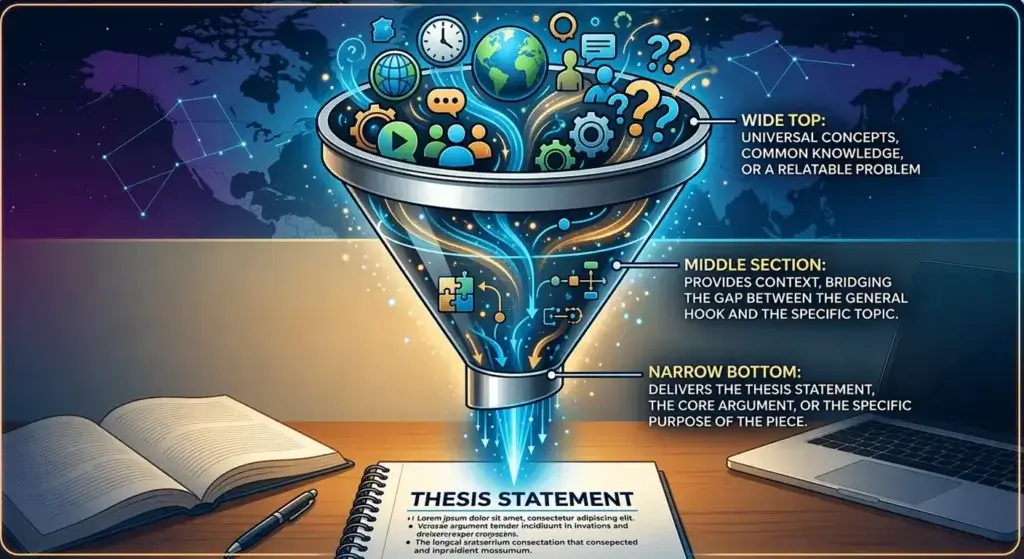
The Funnel Technique, often associated with an “inverted pyramid”, is a structural approach where the writer begins with a broad hook and progressively narrows the scope.
Look at the picture of this funnel.
- The wide top represents universal concepts, common knowledge, and relatable problems.
- Then the middle section provides context and bridges the gap between the general hook and the specific topic.
- Lastly, the narrow bottom delivers the thesis statement or the specific purpose of the piece.
Funnel Technique in writing aligns with cognitive processing. Readers need context before they care about specifics.
So starting broad means you are inviting the reader in. And by narrowing down, you guide them to your specific point without confusion.
| Brandeis University’s writing guide notes that the introduction shifts readers “from the world of daily life into the textual and analytical space of an essay.” |
Why Readers Skip Boring Intros
Understanding the psychology of the reader is crucial. In the age of digital technology, attention is a very limited resource. So when an introduction does not create any sense of relevance, the reader goes away.
A vague and self-indulgent introduction is a crime against the time of readers. Common mistakes include:
- The Dictionary Definition: Starting with Webster defines… is a cliche and contributes nothing.
- The Warm-Up: Trying to write indistinct sentences to get the ball rolling usually leads to a lot of fluff that leaves the audience bored.
- The Thesis Dump: Starting the argument without context leaves the reader unprepared for the importance of the claim.
Readers scan content. HubSpot data indicates that blog bounce rate hits 26-70% on average.
They look for signposts. A funnel introduction therefore in writing is a signpost that tells the reader what is to be read, is organised, and will be worth their time.
Steps to Craft an Intro Using Funnel Technique
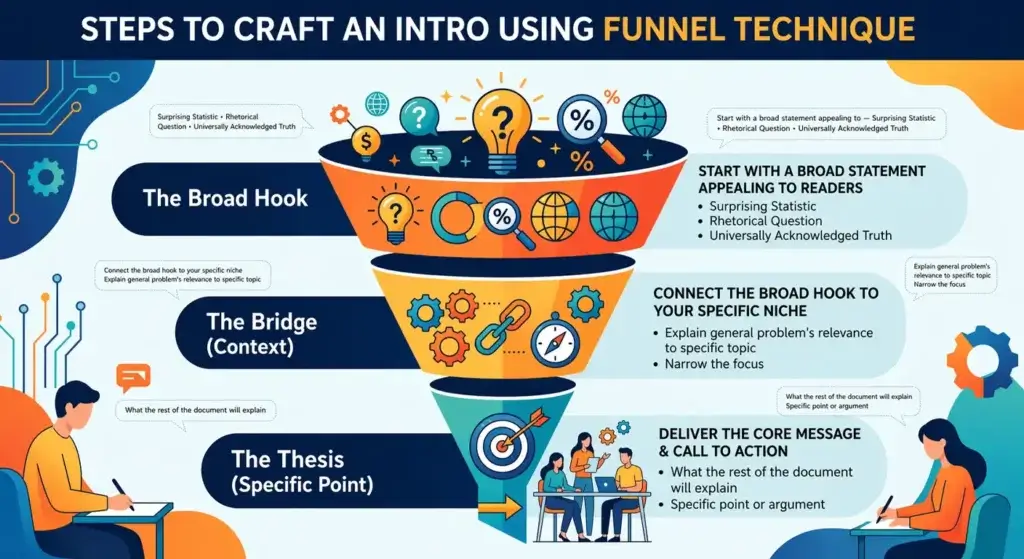
It takes discipline to implement the funnel technique. These are the three steps you need to follow to create a powerful introduction.
1. The Broad Hook
Begin with an appeal to the readers. This could be:
- A surprising statistic
- A rhetorical question
- A universally acknowledged truth
Remember that the goal should be relevant to the topic.
| Example: “We live in an age where we, as a culture, wear exhaustion as a badge of honour. You hear people boasting that they only had four hours of sleep last night as if running on fumes makes them more productive.” |
2. The Bridge (Context)
Connect the broad hook to your specific niche. You should state the reason why the general problem is important to the particular topic at hand. This narrows the focus.
| Example: “Our brains are actually screaming for a rest button while we are trudging our way through the to-do lists. Science is now showing us that the human body does not work better by skipping sleep; we only work more slowly and are prone to mistakes.” |
3. The Thesis (Specific Point)
Deliver the core message. This is the slimmest part of the funnel. It gives the readers a call to action or precisely what the rest of the document will explain.
| Example: “If we really want to get ahead in our lives and careers, then we need to stop glorifying the hustle and start prioritising eight hours of rest.” |
Analysis of the given funnel introduction example:
- Broad: This establishes the scene by giving a general cultural comment that everybody is aware of (bragging about being tired).
- Bridge: Then it ties that culture to the particular biological reality (our brain needs rest, lack of sleep causes errors).
- Narrow: Provides the specific argument/call to action in question (stop glorifying hustle, prioritise eight hours of sleep).
Professional Experience of Applying the Funnel Technique
I am a Content Strategist. In my early career, I had struggled with retention rates. I used to write introduction which were clear as per my understanding. But guess what? The bounce rate was too high.
This was the time when I realised that I was writing for myself and not reader.
Let me tell you the time when I was working to increase organic traffic through copywriting. I started writing about the service offered which felt too direct (bottom of the funnel) while the reader is at the awareness point (beginning of the funnel). This not only lead in less traffic and sales, but also lead to confusion among customers.
But then I connected with assignment writers Malaysia and got introduced to the the funnel technique. I started with a broad search topic which was ‘The importance of mental peace in workplace.” Next I narrowed down to specific advise telling how 10 minutes of meditation can reduce work stress.
Believe me, there were results that could be measured. I saw high user engagement and conversion rates because the content feels purposeful.
So what did we learn? The funnel technique is a lifesaver.
Structural Comparison: Funnel vs. Other Methods
To see the significance of the funnel, let us understand its difference from other writing techniques.
| Feature | Funnel Technique | Chronological Structure | Circular Structure |
|---|---|---|---|
| Flow | General to Specific | Time-based (start to end) | Theme to Theme (at the end, it links back to the beginning) |
| Best for | Literature reviews, persuasive writing, feature articles, news writing | How-to writing, narrative function, historical accounts, resumes/CVs | Reflective writing, memoirs, character development, book hugs |
| Focus | Ideas and depth | Time and sequence | Contrast within the story |
| Main goal | Argumentation/focsuing | Sequencing/narrative | Cohesive |
| Risk | Can be monotonous and cliched | Can lack deeper meaning | Feels like repetitive |
Practical Application Across Different Mediums
The funnel technique adapts to different formats. While the core logic remains constant, the execution varies depending on whether you are writing a blog, an email, an ad copy, or an academic essay.
Tips for Blogs
- Hook with Empathy: Start with a pain point your readers experience in their day-to-day lives. For example, if you are writing a piece on productivity, you can start with something that cuts across the board. Such as being overwhelmed rather than a definition of productivity.
- Use Data Early: It is important to gain authority immediately by stating a shocking piece of information.
- Keep the Bridge Short: Blog readers are skimmers. But always remember to switch between your problem and the solution in 3 sentences.
- Promise Value: Blogs are written to inform readers. So make sure to prioritise value in your content.
Tips for Emails
- Subject Line as the Hook: The main topic in funnel writing is written in the first few sentences. This is your hook point to make the most of it.
- First Sentence Context: The first sentence should validate the subject line and connect it to the recipient’s current situation.
- Direct Call to Action: The narrow point in the email is the ask. You can offer limited time discounts, free trials, or abandoned cart reminders to nudge sale.
- Brevity is the Key: Remember that emails should not be lengthy. You must structure it within two paragraphs maximum.
Tips for Academic Essays
- Academic Tone: The broad hook should be a scholarly observation or a historical trend rather than a rhetorical question.
- Literature Review Gap: A professional essay writing agency uses the middle section to briefly mention existing gaps in research and set the stage for your current argument.
- Precise Thesis: The final sentence of the introduction must be debatable, with a specific claim that supports the rest of the essay. Avoid vague sentences like “This essay will discuss…”
- Roadmap: In lengthy essays, the narrow end of the funnel often includes a brief outline of the arguments to follow.
Common Mistakes to Avoid in Funnel Introductions
- Do not begin with a statement that feels too detached from the specific topic.
- Do not provide excessive information or data in the introduction.
- Never begin with a dictionary definition or with obvious facts.
- Do not make an abrupt jump from general backgroun to the specific topic.
- Failing to address why the topic matters or why the gap in research is worth addressing.
Conclusion
The funnel technique is more than a writing trick; it is a framework for logical communication. It acknowledges the reality of a lower attention span and the need for immediate relevance.
By starting broad, providing context, and narrowing to a thesis, you guide a writer through a logical path that feels natural and engaging.
So whether you are writing a blog, an academic paper, an email, or ad copy, the funnel method provides the clarity required to convey your message effectively.
Get ready and apply the steps outlined above. These include:
- The broad hook
- The bridge (context)
- The thesis (specific point)
Also, avoid vague generalisations and use the funnel to respect your readers’ time.
Once you master this technique, you will stop writing for yourself and start writing for the audience. That is the difference between content that is read and content that is ignored.
FAQs
| 1. What are the three steps for writing a funnel introduction? The three steps used to write a funnel introduction are:
|
| 2. How do I start my essay introduction? You should introduce your specific topic and provide any necessary background information that the reader would need to understand the problem that you are presenting in the paper. |
| 3. Is the funnel technique suitable for all essay types? The funnel technique is often not suitable for all essay types, specifically is applied too rigorously or with over-generalisations. It is best to use for argumentative, expository, and academic papers. |
| 4. How long should each part of the funnel be? Keep the hook 1 sentence, bridge 2-3 sentences for context, and thesis 1 precise sentence to maintain reader interest. |
| 5. Can the funnel technique help with conclusions too? Use the reverse funnel for conclusions: restate thesis narrowly, broaden with implications, and end wth a general call to action. |

